In most cities, you need a passport to travel from Japan to Italy to ancient Rome. In Hamilton, Giovanni just needs his gardening gloves and a good pair of walking shoes. With a gentle smile and a trowel in hand, Giovanni, the head gardener, leads us behind the scenes of one of New Zealand’s most visited attractions. His Italian accent is a soothing melody as he gestures towards the meticulously arranged plants. “Every plant tells a story,” he says, his eyes gleaming with passion. “And every garden is a chapter.”
Giovanni’s journey to Hamilton Gardens is a story in itself. He grew up on a small Tuscan farm, learning the rhythms of the land from his grandfather. But he always yearned to see the world. When he came to Hamilton, he found a canvas for his dreams—a place where he could “collect” gardens from every corner of the globe. “It is my life’s work,” he says, with a deep sense of purpose.
We begin in the Japanese Garden of Contemplation, a place so tranquil you can almost hear the stillness. We walk across a winding bridge over a still pond, filled with vibrant koi. Giovanni explains the art of seasonal transformation, revealing how a single garden can change completely over the year. “In spring, it is all cherry blossoms and new growth. In autumn, the maples turn a fiery red. It is a living canvas,” he whispers, a reverence in his voice. He points out a specific type of moss that he spent years cultivating to achieve the perfect velvet texture, a testament to his patience and vision.
Next, we journey to the Egyptian Garden, a stark and ancient space surrounded by massive pillars and geometric plantings. “This was a challenge,” he admits. “To create this desert-like atmosphere in the humid Waikato climate, we had to be very creative.” The design is based on ancient temple gardens, a place for contemplation and worship. It’s a testament to the innovative concept of the gardens, which aren’t just botanical collections but “collections of garden styles.”
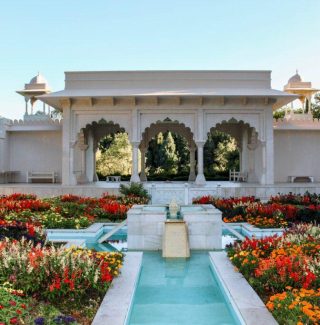
We meet a group of local volunteers, their hands caked in soil, who help bring Giovanni’s vision to life. One of them, a retired schoolteacher named Helen, tells us how the gardens helped her find purpose after retirement. “This isn’t just a garden,” she tells us, her eyes sparkling. “It’s a community. We all have a role to play, from weeding to planning new sections. It’s a place where we can learn and grow, literally.” She points to the Indian Char Bagh Garden, a lush and symmetrical space with a central fountain. “This one is my favorite,” she says. “The scent of the roses is intoxicating, and the symmetrical design is so calming.” She explains how the gardens are a place of year-round blooming cycles, with something new to discover in every season.
As we move on, Giovanni shows us the Chinese Scholars Garden, with its intricate rock formations and traditional pavilions, and the Italian Renaissance Garden, a formal and elegant space with fountains and classic statuary. He shares the tiny details that only a gardener would know—the way the light hits a particular tree in the afternoon, the specific scent of a flower that only blooms at night. He is not just a gardener; he is a storyteller, a curator of plants and histories. As we leave, Giovanni points to an empty patch of ground, a future garden yet to be revealed, and you understand that here, in the heart of Hamilton, a collector’s dream is always in bloom, a work in progress that is constantly evolving, just like the city itself.